
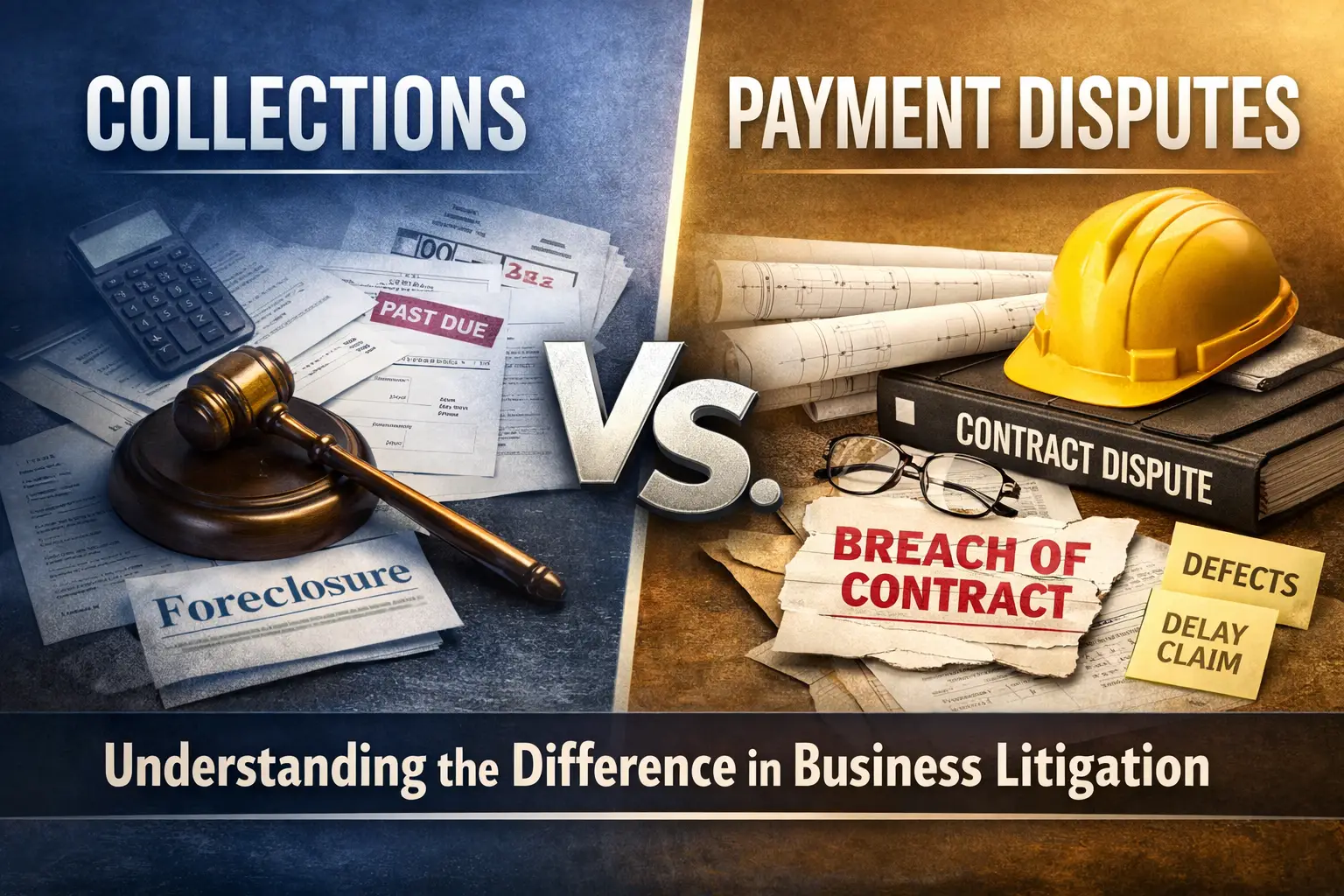
Business owners often describe the problem the same way: “Someone owes us money.” But legally and strategically, not every unpaid balance is the same. Some matters are true collections—where the amount due is largely fixed and the defense options are limited. Others are payment disputes—where the defendant doesn’t just deny owing money, but claims there’s a reason they shouldn’t pay, often tying the dispute to performance, quality, timing, or contract interpretation.
That difference is not academic. It changes how the case must be handled, what evidence matters most, how fast the case can move, and what kind of leverage you can create early.
At Andrew Douglas, P.A. (Douglas Firm), we represent Florida businesses on both sides of these matters—plaintiffs pursuing recovery and defendants responding to claims. Our goal is the same either way: build a litigation posture that puts you in control of risk, cost, and outcome.
What People Mean by “Collections” (and Why Those Cases Can Move Faster)
A classic “collection” case usually involves a debt that is easier to prove because the obligation is already defined and not heavily dependent on performance disputes. In these matters, the defendant may be unable—or unwilling—to pay, but their ability to challenge the underlying obligation is often limited.
Collections commonly involve things like:
- Promissory notes
- Certain loan obligations and guaranties
- Account stated / straightforward unpaid invoices
- Other fixed-debt scenarios where documentation is clean and defenses tend to be narrow
In a true collection matter, success often comes down to documenting the balance properly, proving the contractual basis for the debt, and moving efficiently through litigation procedure. A well-run collections case focuses on avoiding unnecessary detours and positioning for judgment as efficiently as the court system allows.
The key point: in a true collections case, the fight is usually over payment, not over whether payment is owed.
What a “Payment Dispute” Really Is: Unpaid Balance Plus a Defense Narrative
A payment dispute starts the same way—an invoice wasn’t paid—but quickly becomes something else. The defendant’s position is typically not “I can’t pay.” It’s “I shouldn’t have to pay,” or “not that amount,” or “not until you fix what you did.” Once that happens, the case becomes less about the invoice and more about proving entitlement through evidence.
Payment disputes often arise in construction and business-to-business agreements where performance is complex and expectations are contested. Common defenses and counterclaims include:
- “You didn’t perform the contract.”
- “The work was defective.”
- “The work was delayed and caused damages.”
- “The scope changed and the price was never approved.”
- “We have offsets, backcharges, or warranty issues.”
- “You breached first, so we don’t owe the balance.”
Those arguments—whether valid or not—force the case into a litigation posture that requires deeper strategy, stronger evidence development, and careful handling of affirmative defenses and counterclaims.
The key point: in a payment dispute, the plaintiff is often required to prove not just the amount due, but performance and contractual compliance—and the defendant is usually trying to turn the matter into a broader battle over fault.
Why Payment Disputes Require More Sophisticated Litigation Strategy
Many business owners are surprised when a case that seemed “simple” turns into depositions, experts, a document-intensive discovery fight, and multiple dispositive motion opportunities. That’s normal in payment disputes, because the legal issues are rarely limited to a single unpaid invoice.
1) Invoices don’t win payment disputes—evidence does
In a payment dispute, the invoice is usually just the starting point. What matters is the full record: emails, texts, proposals, approvals, change orders, delivery confirmations, job logs, punch lists, and the timeline of communications. If your case is not organized around proof, the other side’s narrative can harden quickly—and that’s when cases become expensive.
2) Affirmative defenses become the battlefield
Defendants in payment disputes commonly file affirmative defenses that sound plausible at first glance. The real work is pressuring those defenses early—forcing specificity, testing whether they’re supported by documents, and exposing when they’re being used as leverage rather than legitimate dispute. When done correctly, this can materially shift settlement posture.
3) Litigation posture is leverage
Payment disputes settle based on risk. Risk depends on how well each side can prove its story. Early strategic steps—targeted discovery, early motion practice when appropriate, and disciplined document development—can change how the case is valued. A case that is “maybe collectible” becomes “dangerous to defend” when the facts are well-organized and the defenses are exposed.
4) Business outcomes matter as much as legal outcomes
In many payment disputes, the client’s business goals are broader than “win a judgment.” You may need to preserve a relationship, protect reputation, prevent future disputes, or avoid operational distraction. A sophisticated approach balances these goals while still building the case as if it may need to be tried.
A Practical Reframe: “Owed Money” vs. “Owed Money Plus a Story”
A quick way to distinguish the two:
- Collection case: someone owes money, and the dispute is primarily about nonpayment.
- Payment dispute: someone owes money, but they’ve built a story about why they don’t have to pay.
Once a story exists—especially one involving alleged breach, defective work, or delay—your attorney must do more than “collect.” The job becomes proving entitlement while systematically dismantling defenses and positioning the matter for resolution on favorable terms.
Common Examples of Business Payment Disputes We See
In Florida business litigation, these are frequent examples of matters that are mislabeled as “collections” but are really payment disputes:
- Contractor vs. owner disputes over scope, quality, and change orders
- Subcontractor nonpayment where the GC alleges defective or incomplete work
- Vendor/supplier disputes involving rejected goods, delivery issues, or offsets
- Service agreement disputes where the client claims “poor performance”
- Business contract disputes involving termination, warranties, or milestone obligations
- Guaranty disputes tied to underlying performance allegations
In these cases, the legal analysis is only one piece. The real task is creating a litigation roadmap that anticipates defenses and controls the narrative through evidence.
Our Approach at Douglas Firm
At Andrew Douglas, P.A., we approach payment disputes with the same seriousness and structure as any commercial litigation matter:
- Early case assessment to identify likely defenses and counterclaims
- Evidence-driven strategy built around timeline, communications, and documentation
- Targeted discovery designed to force the other side into provable positions
- Motion practice where appropriate to narrow issues and increase leverage
- Settlement strategy aligned with business goals—not just “splitting the difference”
We represent plaintiffs seeking recovery and defendants responding to claims, including businesses that need to assert legitimate defenses without letting the case spiral into uncontrolled risk.
When You Should Call a Litigation Attorney—Not a “Collections-Only” Lawyer
You’ll usually want litigation counsel early if:
- the other side is alleging defective work, delay, or nonperformance
- you anticipate counterclaims, backcharges, or offsets
- the contract has detailed notice, scope, or milestone requirements
- the communications record is messy or heavily verbal
- there are multiple parties (owner/GC/subs/vendors)
- you need a strategy that protects your business long-term, not just a short-term judgment
Talk With a Florida Business Litigation Attorney About Your Options
If you’re facing nonpayment—or you’ve been sued for nonpayment—the first step is identifying what kind of case it really is. Collections can often be handled efficiently. Payment disputes require a litigation strategy built around proof, leverage, and risk management.
Andrew Douglas, P.A. represents Florida businesses in collections, construction payment disputes, and commercial litigation. If you want a practical plan—whether you’re pursuing money or defending a claim—contact our office to discuss strategy.
Disclaimer: This article is for general informational purposes only and does not constitute legal advice. Every case is fact-specific. Consult counsel regarding your particular situation.