
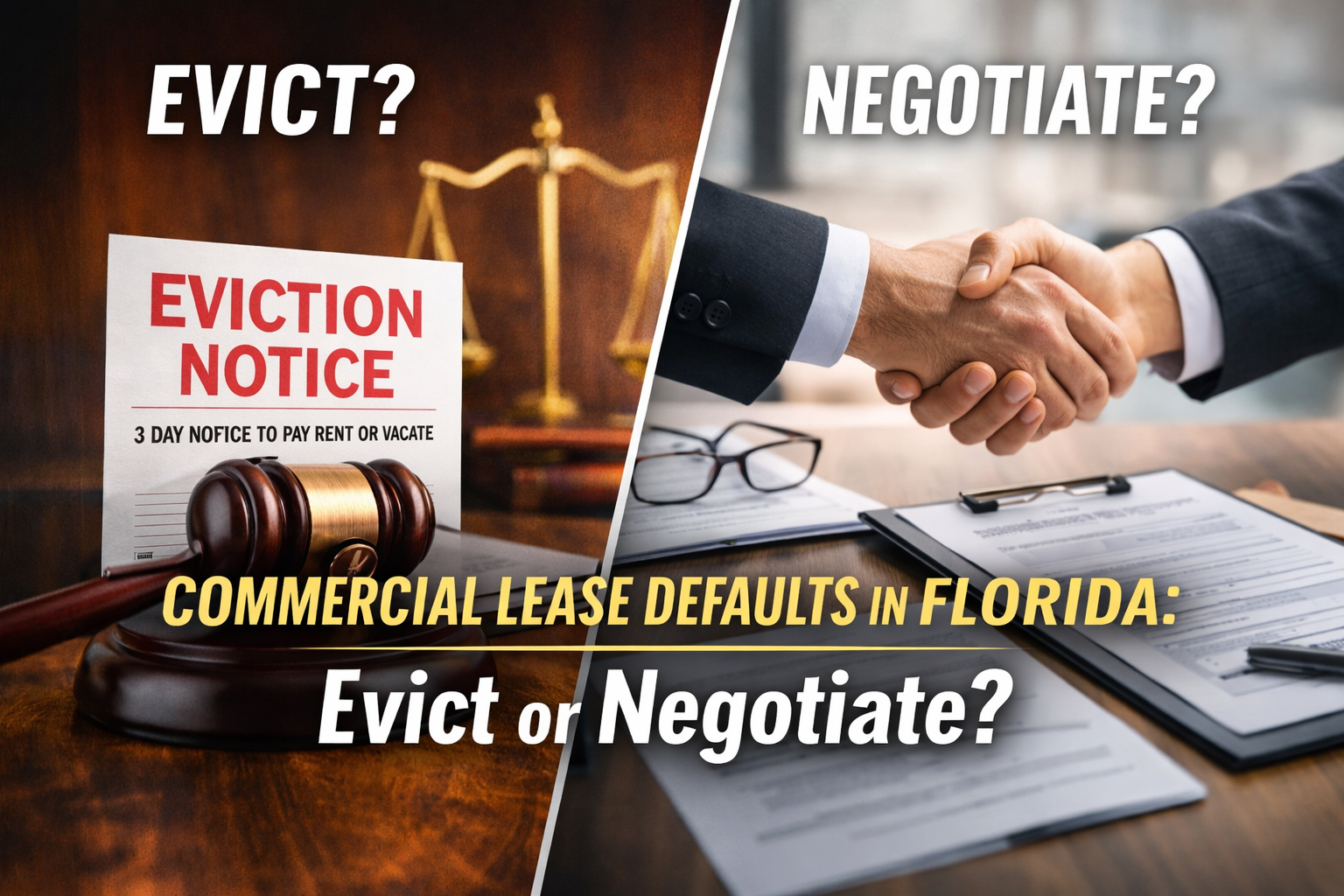
When a commercial tenant defaults under a lease, Florida landlords face a critical decision: pursue a commercial eviction or attempt a negotiated resolution. While Florida law provides strong remedies for landlords, eviction is not always the most financially advantageous strategy.
Understanding when to evict a commercial tenant in Florida — and when negotiation better protects your investment — requires a legal and economic analysis. This guide explains how commercial lease defaults work under Florida law and how landlords can evaluate their options strategically.
What Is a Commercial Lease Default in Florida?
A commercial lease default occurs when a tenant violates the terms of the lease agreement. Unlike residential tenancies, commercial leases in Florida are governed primarily by contract terms and Chapter 83, Part I, Florida Statutes.
Commercial lease defaults typically fall into two categories:
Monetary Defaults
Monetary defaults involve nonpayment of financial obligations, including:
- Failure to pay rent
- Partial rent payments
- Failure to pay CAM charges
- Nonpayment of taxes or insurance
- Failure to replenish a security deposit
In most cases, a landlord must serve a 3-Day Notice to Pay Rent or Vacate before filing a Florida commercial eviction lawsuit.
Non-Monetary Defaults
Non-monetary defaults may include:
- Unauthorized use of the premises
- Improper assignment or subleasing
- Failure to maintain required insurance
- Code violations
- Illegal activity
- Abandonment of the property
These often require a 7-Day Notice to Cure or Terminate, depending on the lease terms.
The nature of the default is the first factor in determining whether eviction or negotiation is appropriate.
When to Evict a Commercial Tenant in Florida
In many situations, pursuing a Florida commercial eviction is the most effective way to protect your asset.
1. Repeated Nonpayment of Rent
If the tenant has a pattern of late or missed payments, continued accommodation may weaken your leverage. Warning signs include:
- Multiple prior payment plans
- Arrearages exceeding 60 days
- Bounced checks
- Avoidance of communication
Florida commercial eviction procedures move quickly, particularly in nonpayment cases where tenants must deposit rent into the court registry to contest the case.
2. Tenant Abandonment
If the tenant has vacated the premises or ceased operations, prompt legal action helps minimize vacancy losses and allows you to re-lease the space.
3. Strong Lease Remedies
Eviction is often strategically advantageous when the lease includes:
- An acceleration clause
- A personal guarantee
- Attorney’s fee provisions
- Clear default and termination language
Florida courts strictly enforce commercial lease terms negotiated between sophisticated parties.
4. Risk to Property or Other Tenants
If the tenant’s conduct exposes the property to liability — such as code violations or illegal activity — swift enforcement is typically necessary.
5. Favorable Market Conditions
If market demand is strong, regaining possession quickly may generate greater long-term returns than attempting to salvage a failing tenancy.
When Negotiation May Be the Better Option
Eviction is a legal remedy. Negotiation is a business strategy. In some circumstances, negotiation may reduce losses and preserve value.
1. Temporary Cash Flow Issues
If the tenant’s hardship appears temporary, a structured workout agreement may allow the landlord to recover arrears without incurring vacancy costs.
Before negotiating, landlords should request:
- Updated financial statements
- Business performance reports
- A proposed repayment plan
2. High Vacancy Risk
If re-leasing the property may take months, the cost of vacancy could exceed the tenant’s arrearage.
Eviction-related costs may include:
- Legal fees
- Court costs
- Sheriff fees
- Leasing commissions
- Tenant improvement expenses
- Carrying costs during vacancy
3. Specialized Build-Out Spaces
Restaurants, medical offices, and industrial properties often require substantial improvements. Replacing these tenants can be expensive and time-consuming.
4. Long-Term Tenant with Strong History
A tenant with years of reliable payment history may justify a carefully structured lease modification or forbearance agreement.
Financial Comparison: Eviction vs. Negotiation
Before deciding, Florida commercial landlords should perform a disciplined financial analysis.
Cost Factors for Eviction
- Outstanding rent balance
- Legal fees (contested vs. uncontested case)
- Time to regain possession (often 2–4 weeks uncontested)
- Time to secure a new tenant
- Risk of tenant bankruptcy
Cost Factors for Negotiation
- Risk of repeated default
- Reduced rental income
- Opportunity cost in rising markets
- Declining guarantor financial strength
The correct decision is not emotional — it is asset-driven.
Risks of Delaying a Florida Commercial Eviction
Delaying enforcement can create legal and financial complications.
Waiver of Default
Accepting partial rent without proper reservation language may waive certain enforcement rights.
Bankruptcy Risk
Financially distressed commercial tenants may file for Chapter 11 or Chapter 7 bankruptcy protection, triggering an automatic stay that halts eviction proceedings.
Deterioration of Guarantor Assets
Delay may reduce the likelihood of recovery under a personal guarantee.
Procedural Errors
Improper notice or inconsistent enforcement can undermine an otherwise valid commercial eviction case.
Precision matters in Florida commercial landlord litigation.
Using the Eviction Process as Leverage
Filing a commercial eviction lawsuit does not eliminate negotiation opportunities. In fact, it often strengthens them.
In Florida nonpayment cases:
- Tenants must respond quickly.
- Rent must be deposited into the court registry.
- Failure to deposit can result in default judgment.
This statutory structure creates significant leverage for landlords.
Practical Checklist for Florida Commercial Landlords
Before deciding whether to evict or negotiate, evaluate:
- Total amount of arrearage
- Tenant’s financial stability
- Strength of personal guarantee
- Market vacancy rates
- Remaining lease term
- Estimated re-leasing timeline
- Bankruptcy exposure
- Prior default history
- Property liability risks
- Litigation cost versus recovery potential
When risk factors compound, eviction is often the prudent course. When long-term asset value favors stability, negotiation may preserve greater return.
Protecting Your Rights as a Florida Commercial Landlord
Florida commercial eviction law provides landlords with powerful enforcement tools. However, the ultimate objective is not simply regaining possession — it is protecting the value of your commercial property and maximizing recovery.
If you are facing a commercial lease default in Florida, early legal guidance can preserve leverage and prevent costly procedural mistakes.
Contact Douglasfirm to discuss your Florida commercial eviction strategy and protect your investment.