
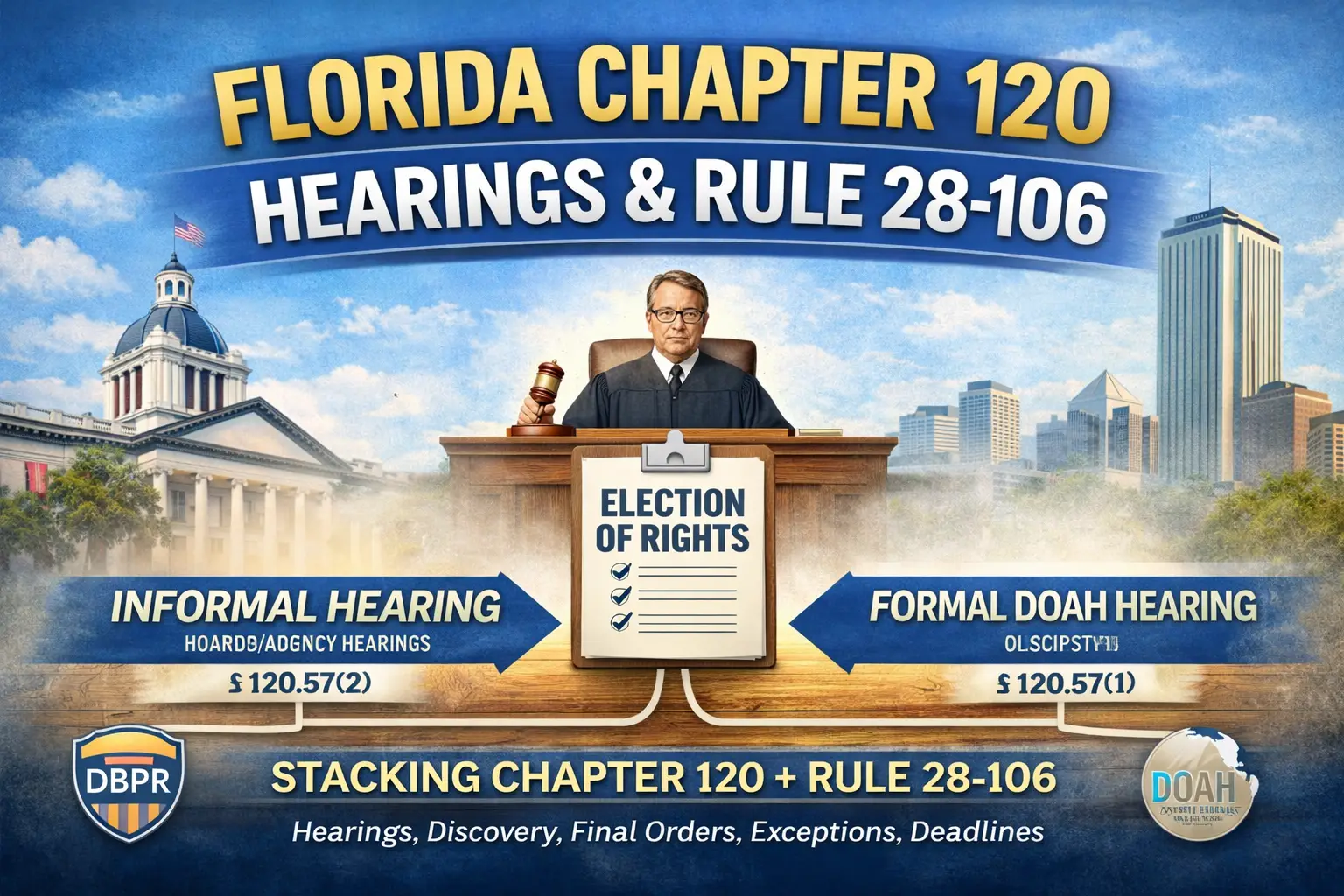
A practical, guide for DBPR and other Florida administrative cases
This article is for general information and does not constitute legal advice. Administrative practice is deadline-driven and can be unforgiving—always verify the controlling notice, agency rules, and any case-specific orders.
Why Chapter 120 matters
Florida’s Administrative Procedure Act (APA)—Chapter 120—is the default playbook for how Florida agencies (including boards that regulate licensed professionals) make decisions that affect someone’s substantial interests. When an agency’s decision affects a person or business in a meaningful way (license discipline, denials, restrictions, fines, etc.), the APA requires notice and a meaningful opportunity to be heard.
Two provisions are the backbone of most contested cases:
- § 120.569: sets the general framework for proceedings that determine substantial interests and ties the case to the correct hearing type depending on whether material facts are disputed.
- § 120.57: sets the two main hearing tracks—formal (trial-like) hearings and informal hearings—and provides key timing rules after a recommended order.
Rule 28-106: what it is (and when it applies)
Florida’s Uniform Rules of Procedure—Chapter 28-106, Florida Administrative Code—supply the nuts-and-bolts “rules of court” for APA hearings: petitions, answers, motions, discovery, subpoenas, evidence, prehearing stipulations, recommended orders, and exceptions.
Scope: hearings yes, investigations no
Rule 28-106.101 makes this distinction clear: Chapter 28-106 applies to proceedings determining substantial interestsunder Chapter 120, but it does not apply to “agency investigations or determinations of probable cause preliminary to agency action.”
Practical translation (DBPR discipline):
- Investigation / probable cause phase → generally not governed by 28-106 (that phase is typically under profession statutes like Ch. 455 + the board’s rules).
- After an administrative complaint is served (the hearing phase) → Chapter 120 + 28-106 is usually the procedural backbone.
The “Point of Entry” and the 21-day problem
If there is one concept that drives administrative outcomes, it is timely point of entry.
Rule 28-106.111 provides (unless another law says otherwise) that a person seeking a hearing on an agency decision must file a petition within 21 days of receipt of written notice.
For disciplinary cases: the administrative complaint is the petition
Most DBPR disciplinary matters are “agency enforcement/disciplinary actions.” Uniform Rule 28-106.2015 treats the agency’s administrative complaint as the petition, and service of the complaint is deemed the initiation of proceedings.
That’s why DBPR typically serves an Administrative Complaint with a Notice of Rights / Election of Rights (EOR): it’s the practical tool for triggering your Chapter 120 hearing rights under the correct track (formal vs informal).
Formal vs informal hearings: choosing the right lane under § 120.57
✅ Formal hearing — § 120.57(1): disputed material facts (DOAH track)
When a case involves disputed issues of material fact, the APA defaults to a formal hearing under § 120.57(1).
These hearings are typically conducted at the Division of Administrative Hearings (DOAH) before an Administrative Law Judge (ALJ).
✅ Informal hearing — § 120.57(2): no disputed material facts (board/agency track)
If there are no disputed issues of material fact, § 120.57(2) generally governs, and the case is usually presented to the board/agency with the focus on mitigation and the appropriate outcome, not a trial on what happened.
Rule of thumb:
- If you truly dispute key facts → elect DOAH/formal.
- If facts are essentially admitted/undisputed and you’re fighting about sanction/mitigation → informal may fit.
- Focus: mitigation / penalty
- Usually heard by Board/Agency
- Ends in Final Order
- Case management order + deadlines
- Discovery (Rule 28-106.206; FRCP 1.280–1.400)
- Subpoenas (Rule 28-106.212)
- Prehearing stipulation (Rule 28-106.209)
- Final hearing → Recommended Order → Exceptions (Rule 28-106.217) → Final Order
The litigation mechanics (Rule 28-106, Part II) — what you should expect
1) Pleadings: administrative complaint, then answer (sometimes)
- Administrative complaint contents (discipline cases): Rule 28-106.2015 lists what the complaint must contain—agency/respondent identification, the statutes/rules alleged to be violated, and the facts/conduct relied upon.
- Answer: Rule 28-106.203 allows a respondent to file an answer.
- Service: Rule 28-106.110 describes service of papers in the proceeding.
2) Motions: protective orders, motions to compel, continuances, etc.
Rule 28-106.204 governs motions practice (format, filing, disposition). (This is where discovery disputes are typically fought.)
3) Discovery: civil-style discovery in formal cases
Rule 28-106.206 is the discovery engine. After commencement of a proceeding, parties may obtain discovery through the means and manner of Florida Rules of Civil Procedure 1.280–1.400, and the presiding officer may issue discovery orders and sanctions (except contempt).
What that usually includes (formal/DOAH cases):
- Requests for production (including ESI)
- Interrogatories
- Requests for admission
- Depositions (party and nonparty)
- Protective orders / motions to compel
4) Subpoenas: getting witnesses and documents
Rule 28-106.212 requires the presiding officer to issue subpoenas upon request (for deposition or hearing witnesses), and the requesting party specifies whether documents are required.
5) Prehearing conference and stipulation: narrowing the battlefield
Rule 28-106.209 authorizes the presiding officer to direct parties to confer to simplify issues, examine exhibits, exchange witness lists, and enter a prehearing stipulation—often the single most important document for trial efficiency.
6) Evidence, record, and what “counts”
Rule 28-106.213 addresses evidence mechanics in these proceedings (and DOAH practice is generally record-driven—build your record like it’s going to appeal).
Separately, § 120.57 supplies key evidentiary principles and procedural protections in the formal hearing track.
7) Recommended Order → Exceptions → Final Order (the endgame)
In formal hearings, the ALJ issues a Recommended Order (RO). After that:
- Parties can file exceptions (and responses) under Rule 28-106.217.
- § 120.57 also includes critical timing and procedure for final agency action after the RO.
Practice point: Exceptions are not “re-argument.” They are targeted attacks on specific findings/conclusions and must be tied to record citations.
A realistic timing outline (how these cases usually move)
Every case varies, but the lifecycle often looks like this:
- Administrative Complaint served (discipline/enforcement) → EOR/notice triggers deadlines.
- Point of entry response (often ~21 days unless otherwise stated).
- If formal: referral to DOAH and ALJ assignment (DOAH initial handling is reflected in Chapter 120 provisions governing the division’s role and assignment mechanics).
- Case management order with discovery cutoffs, witness/exhibit lists, and hearing date (set by ALJ).
- Discovery / depositions (civil-rule style).
- Prehearing stipulation (often required).
- Final hearing → Recommended Order → Exceptions → Final Order.
How this ties back to DBPR disciplinary cases (the short version)
For DBPR license discipline, your “rules stack” commonly looks like:
- Substantive authority (what is a violation / what penalties exist): profession statutes + board rules (varies by board).
- Hearing rights and structure: § 120.569 + § 120.57.
- Procedure (pleadings, discovery, subpoenas, prehearing): Rule 28-106.
- Disciplinary case initiation mechanics: Rule 28-106.2015 (admin complaint as petition; service initiates).
Practical checklist for licensees and businesses
✅ Calendar the point-of-entry deadline immediately. Do not assume you “have time.”
✅ Decide early whether you truly dispute material facts. That decision drives whether the case belongs at DOAH.
✅ If formal/DOAH, treat it like litigation from day one. Serve targeted discovery and lock down third-party documents with subpoenas.
✅ Build the record for exceptions and appeal. Your “best arguments” won’t matter if they aren’t supported in the evidentiary record.