
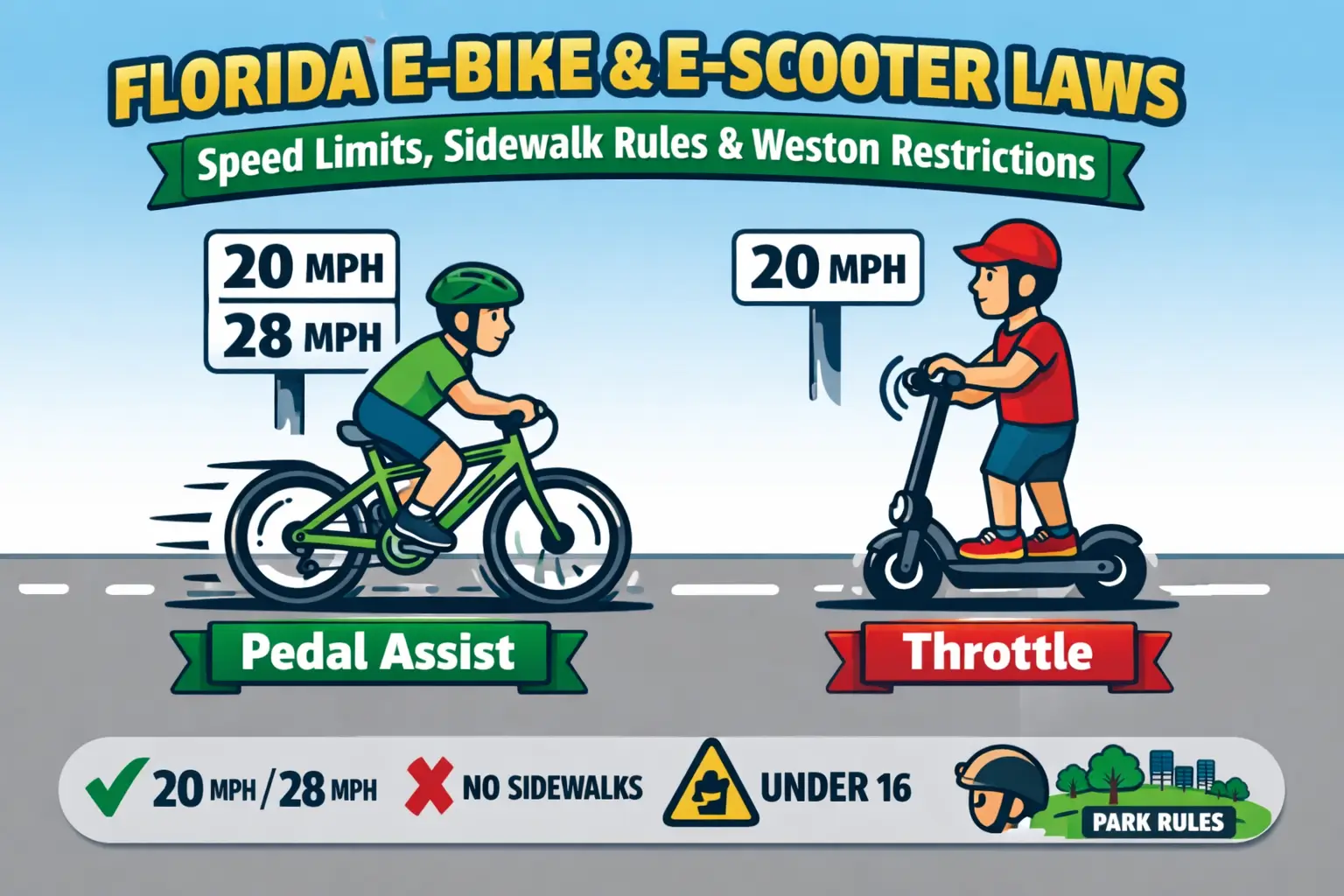
Speed Limits, Sidewalk Rules, Age Requirements (Including Weston, Florida Restrictions)
Electric bikes and electric scooters are now common across Florida neighborhoods, sidewalks, and parks. But Florida law draws clear legal boundaries based on speed capability, device classification, and location—and local governments, including the City of Weston, can impose additional restrictions.
This guide explains the rules in plain English, with a special call-out for Weston’s park-specific regulations.
⚙️ Florida Device Classifications (Speed = Legality)
Florida law focuses on what the device can do, not how it’s marketed.
✔ Electric Bicycles (E-Bikes)
To qualify as an e-bike, the device must have operable pedals, a seat, and a motor under 750 watts, and fit one of these classes:
| E-Bike Class | Motor Operation | Max Assisted Speed |
|---|---|---|
| 🟢 Class 1 | Pedal-assist only | 20 mph |
| 🟢 Class 2 | Throttle allowed | 20 mph |
| 🟢 Class 3 | Pedal-assist only | 28 mph |
✔ If motor assistance stops at these speeds, the device remains legally an electric bicycle.
⚡ Quick Explanation: Pedal Assist vs. Throttle Allowed
✔ Pedal Assist means the motor only works when you pedal. If you stop pedaling, the motor stops. These are Class 1 (20 mph) and Class 3 (28 mph) e-bikes and are generally treated most like traditional bicycles.
🛵 Throttle Allowed means the motor can move the bike without pedaling using a grip or button. These are Class 2 e-bikes and must stop providing power at 20 mph to remain legal.
⚠️ Why it matters: Throttle-enabled bikes are more likely to be restricted by cities, HOAs, and parks—and if a throttle bike exceeds 20 mph, it is no longer a legal e-bike under Florida law.
✖ Motorized Scooters
A device is only a motorized scooter if it is:
✔ Designed not to exceed 20 mph on level ground
If it can go faster, it no longer qualifies as a scooter under Florida law.
🚫 Devices That Go Over 28 mph
Devices capable of exceeding 28 mph under motor power fall outside Florida’s e-bike and scooter definitions.
| Speed Capability | Legal Classification |
|---|---|
| 29–30 mph | ⚠️ Likely a moped |
| Over 30 mph | 🚫 Motorcycle / motor vehicle |
🚨 These devices:
- ❌ Are not e-bikes
- ❌ Are not scooters
- ❌ May not be used on sidewalks, trails, or bike paths
🚶 Sidewalk Rules in Florida
✔ Bicycles & E-Bikes
Florida law generally allows bicycles—and therefore e-bikes—to be used on sidewalks unless a local ordinance restricts them.
However:
✔ Pedestrians always have the right of way
✔ Riders must give an audible warning before passing
✔ Speed must be reasonable for pedestrian conditions
⚠️ High-speed or aggressive riding on sidewalks can still result in citations or civil liability.
⚠️ Electric Scooters
Scooter sidewalk use is primarily governed by local ordinance:
✔ Some cities allow sidewalk use
✖ Others prohibit it
⚠️ Many restrict scooters to bike lanes or roadways
👉 Always check your city’s code.
🧒 Age & Helmet Requirements (Florida)
| Requirement | Florida Rule |
|---|---|
| Helmet use | ✔ Required for riders under 16 on bicycles & e-bikes |
| Minimum age | ✖ No statewide minimum |
| Local age rules | ⚠️ Cities may impose age limits |
🏙️ Weston, Florida: Local Rules You Must Know
While Florida law provides the framework, Weston has adopted stricter local rules, particularly in city parks and recreational facilities.
🚫 Weston City Parks & Recreational Areas
In Weston, the following may not be operated within city parks:
✖ Electric bicycles
✖ Motorized scooters
✖ Motorized mobility devices
✔ Exception: These devices may be used only on:
- 🛣️ Park roads
- 🅿️ Designated parking areas (for parking purposes only)
🟡 Weston Park Road Speed Limit
When operating on a park road in Weston:
🚦 Maximum speed: 15 mph
This limit applies regardless of the device’s higher design speed.
📊 Florida vs. Weston — Quick Comparison
| Issue | Florida State Law | Weston Local Rule |
|---|---|---|
| E-bike sidewalk use | ✔ Generally allowed | ⚠️ Restricted in parks |
| Scooter sidewalk use | ⚠️ Local control | 🚫 Restricted in parks |
| Park access | ✔ If otherwise lawful | 🚫 Roads & parking only |
| Speed in parks | Varies | 15 mph max |
| Devices over 28 mph | 🚫 Not e-bikes | 🚫 Prohibited |
⚖️ Why These Rules Matter
Even lawful sidewalk use comes with risk:
⚠️ Sidewalks are pedestrian-first zones
⚠️ Riders owe a heightened duty of care
⚠️ Devices exceeding statutory definitions lose legal protections
🚨 In injury cases, enforcement actions, and HOA disputes, courts look at:
- Device classification
- Speed capability
- Location of operation
- Applicable local ordinances (like Weston’s park rules)
📚 Legal References & Authorities Cited
The following Florida statutes and local ordinances are referenced or summarized in this article. Links are provided for readers who want to review the underlying law directly.
🏛️ Florida Statutes (Chapter 316 – State Uniform Traffic Control)
✔ Fla. Stat. § 316.003 — Definitions
Defines electric bicycles, motorized scooters, mopeds, and related terms, including the 20 mph, 28 mph, and 30 mphspeed-based classifications.
🔗 https://www.leg.state.fl.us/statutes/index.cfm?App_mode=Display_Statute&URL=0300-0399/0316/Sections/0316.003.html
✔ Fla. Stat. § 316.2065 — Bicycle Regulations
Governs bicycle operation on roadways and sidewalks, including the duty to yield to pedestrians and provide an audible warning when passing on sidewalks.
🔗 https://www.leg.state.fl.us/statutes/index.cfm?App_mode=Display_Statute&URL=0300-0399/0316/Sections/0316.2065.html
✔ Fla. Stat. § 316.20655 — Electric Bicycles
Treats qualifying e-bikes as bicycles under Florida law and authorizes local governments to regulate certain aspects of e-bike use.
🔗 https://www.leg.state.fl.us/statutes/index.cfm?App_mode=Display_Statute&URL=0300-0399/0316/Sections/0316.20655.html
✔ Fla. Stat. § 316.2128 — Micromobility Devices & Motorized Scooters
Addresses operational rules for motorized scooters and micromobility devices, including licensing and registration exemptions.
🔗 https://www.leg.state.fl.us/statutes/index.cfm?App_mode=Display_Statute&URL=0300-0399/0316/Sections/0316.2128.html
🏙️ City of Weston, Florida — Local Ordinances
✔ City of Weston Code of Ordinances, Chapter 100 — Parks & Recreation
Restricts electric bicycles, motorized scooters, and motorized mobility devices in city parks, allowing operation only on park roads and designated parking areas, with a 15 mph speed limit on park roads.
🔗 https://codelibrary.amlegal.com/codes/weston/latest/weston_fl/0-0-0-3669
✔ City of Weston Public Safety & Transportation Guidance
City-published guidance reinforcing park restrictions, speed limits, and pedestrian safety expectations.
🔗 https://www.westonfl.org/residents/bicycle-traffic-safety/e-bike-e-scooter-safety
⚠️ Important Note
Local ordinances can change and may differ by city or county. Riders should always review the municipal code applicable to their specific location, especially when operating e-bikes or scooters on sidewalks, in parks, or near schools.
🧠 Key Takeaways
✔ Speed capability determines legality
✔ 20 mph and 28 mph thresholds speeds that determine classification and use
✔ Sidewalks are not high-speed corridors
✔ Weston parks impose stricter limits than state law
✔ Local ordinances can override general assumptions
🚸 Underage Riders & Overpowered E-Bikes: Legal Risks Parents Often Miss
A growing issue across Florida involves minors riding e-bikes or scooters that exceed legal limits, either by motor wattage, speed capability, or modification. These devices are frequently marketed as “e-bikes,” but Florida law is definition-driven, not marketing-driven.
⚠️ The Legal Thresholds That Matter
Under Florida law:
✔ An electric bicycle must have operable pedals, a seat, and a motor not exceeding 750 watts, and motor assistance must cut off at 20 mph (Class 1 & 2) or 28 mph (Class 3)
📘 See Fla. Stat. § 316.003 (definitions of electric bicycle and classes)
🔗 https://www.leg.state.fl.us/statutes/index.cfm?App_mode=Display_Statute&URL=0300-0399/0316/Sections/0316.003.html
🚫 A device that exceeds these limits is not an electric bicycle under Florida law—even if it has pedals.
🚫 When an “E-Bike” Stops Being an E-Bike
Devices commonly used by minors may fall outside Florida’s e-bike framework when they:
⚠️ Exceed 750 watts of motor power
⚠️ Are capable of more than 28 mph under motor power
⚠️ Have speed governors removed or bypassed
⚠️ Operate primarily by throttle without pedaling beyond allowed limits
📌 Once outside the statutory definition, the device may instead fall under motorized scooter, moped, or motor vehicle classifications, each of which carries different legal restrictions.
📘 See generally Fla. Stat. § 316.003
🔗 https://www.leg.state.fl.us/statutes/index.cfm?App_mode=Display_Statute&URL=0300-0399/0316/Sections/0316.003.html
🧒 Why This Is Especially Risky for Minors
When a minor operates an overpowered or improperly classified device:
🚫 Sidewalk use may be unlawful
🚫 Park use may be prohibited by local ordinance
🚫 The device may legally be treated as a motor vehicle, and civil and criminal violations related to motor vehicles may apply!
🚫 Required licensing or operational rules may be unmet
Florida law allows local governments to further regulate the operation of e-bikes, including where they may be ridden.
📘 See Fla. Stat. § 316.20655
🔗 https://www.leg.state.fl.us/statutes/index.cfm?App_mode=Display_Statute&URL=0300-0399/0316/Sections/0316.20655.html
⚖️ Liability Exposure for Parents
In the event of an accident involving a minor on an overpowered device:
⚠️ Courts may view the device as an unlawful or improperly operated motor vehicle
⚠️ Parents may face claims for negligent supervision or negligent entrustment
⚠️ Homeowner and auto insurance policies often exclude coverage for unregistered or illegal motor vehicles
📌 These risks are heightened when incidents occur on sidewalks, bike paths, school zones, or city parks, where pedestrians are expected to be present.
🧠 Key Takeaway for Parents
✔ Verify the motor wattage (750W or less)
✔ Confirm the maximum assisted speed (20 mph or 28 mph, depending on class)
✔ Be cautious of devices advertised at 35–45 mph
✔ Understand that modifications can change the device’s legal status
🚨 Under Florida law, a device that does not meet the statutory definition of an e-bike does not gain protection simply because a child is riding it.