
Why this matters for Florida roofers?
Florida law now requires specific “consumer notice” language in residential roof repair and roof replacement contracts—and the required language is not optional. Missing it can create contract risk (owner cancellation/voiding rights) and can also trigger DBPR/CILB discipline.
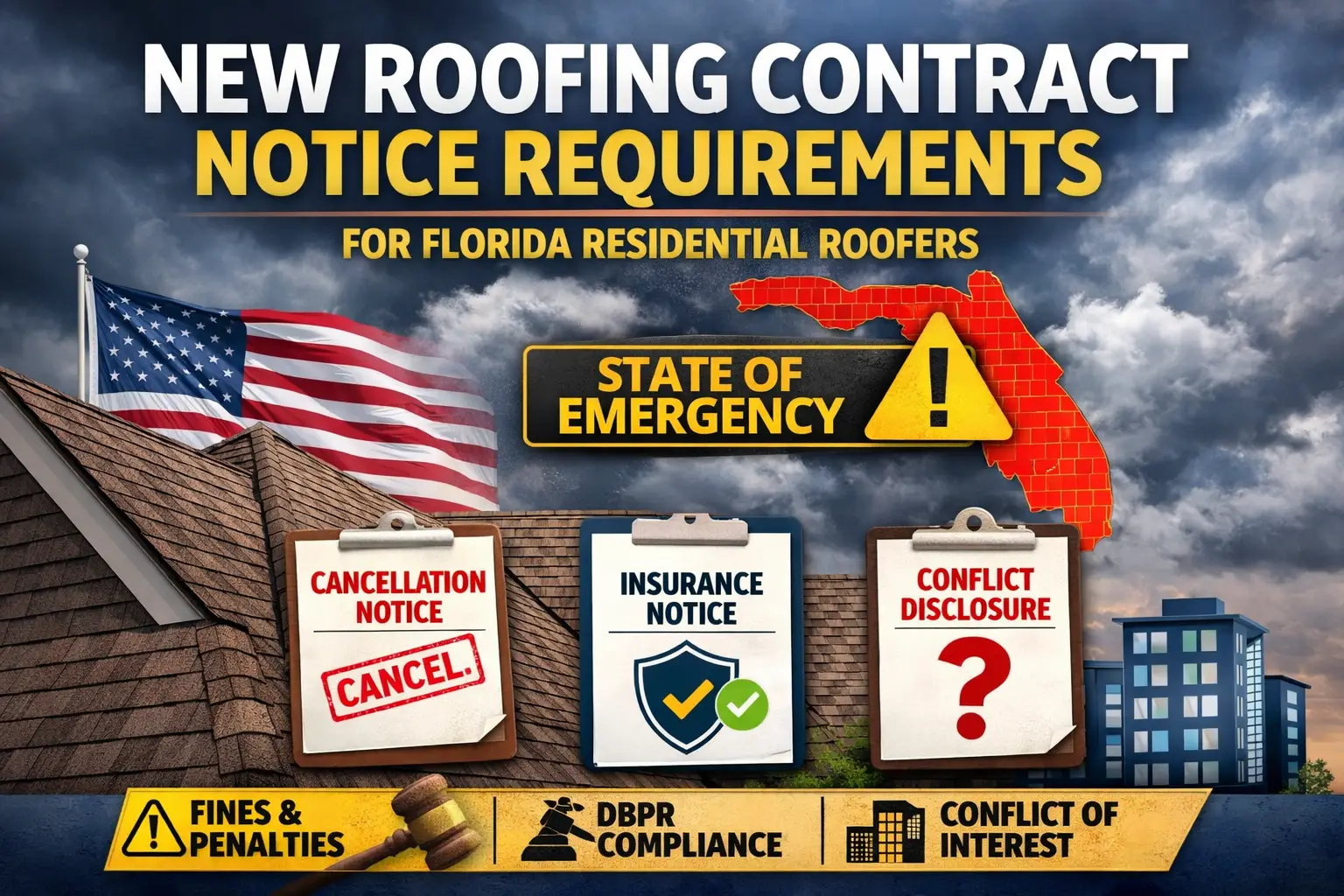
Below are the three compliance items I’m seeing most often in DBPR/CILB enforcement conversations:
✅ (1) State-of-emergency cancellation notice (Fla. Stat. § 489.147(6))
✅ (2) Insurance coverage notice (Fla. Stat. § 489.147(7))
✅ (3) Conflict-of-interest disclosure tied to milestone inspections/SIRS work (Fla. Stat. § 553.899(12))
1) Required “State of Emergency” cancellation notice (Fla. Stat. § 489.147(6))
When it applies
A residential owner gets a statutory right to cancel without penalty/obligation within 10 days after signing (or by the “official start date,” whichever comes first) if the contract was entered into within 180 days of events that are the subject of a Governor-declared state of emergency, and the property is in the geographic area covered by the declaration.
Florida law defines the “official start date” in this context as the date work begins that includes installation of materials that will be part of the final roof work, or a permit is issued, or a qualifying temporary repair is made.
Practice tip: This notice requirement is triggered by the emergency declaration + timing/geography—not by whether the job is “storm related” in the way the parties may think about it. Draft conservatively.
The required contract language (copy/paste)
The statute requires the following language in bold, at least 14-point font, immediately before the owner signature line:
“You, the residential property owner, may cancel this contract without penalty or obligation within 10 days after the execution of the contract or by the official start date, whichever comes first, because this contract was entered into within 180 days of events resulting in the declaration of a state of emergency by the Governor.”
“180 days” note
The “within 180 days” language reflects more recent legislative changes.
2) Required “Insurance Coverage” notice (Fla. Stat. § 489.147(7))
This one is simpler: if you execute a contract to repair/replace a roof on residential property, the contract must include (or attach) the statutory insurance notice in bold, at least 14-point font, on the owner signature page:
“If the proposed work is related to an insurance claim, you, the residential property owner, should contact your insurance company to verify coverage for the proposed roofing work, including any claims, deductibles, and policy terms, before signing this contract.”
Why this matters: It’s an easy compliance win that reduces “I thought insurance covered it” disputes—and it’s a clean target in DBPR paperwork reviews.
3) Milestone inspection / SIRS conflict-of-interest disclosure (Fla. Stat. § 553.899(12))
This issue shows up a lot in the condo space—especially after milestone inspections and structural integrity reserve study (SIRS) planning.
Who must disclose
If a licensed architect/engineer bids to perform a milestone inspection, they must disclose in writing their intent to bid on maintenance/repair/replacement work that may be recommended. The statute also addresses conflicts involving a “design professional” and contractors bidding the resulting repair work, including relationships and ownership interests.
Why roofers should care
If you’re bidding re-roofing or related repair scopes that flow out of a milestone inspection/SIRS-driven project, this statute can get pulled into:
- bid protests / vendor disputes,
- contract termination fights, and
- DBPR complaint narratives.
The law provides that certain contracts may be voidable, and it lays out consequences tied to disclosure and termination.
What about fines and DBPR discipline?
At a high level, failure to comply with these statutory requirements can be treated as a disciplinary issue (and may also be handled through citations depending on the facts and DBPR posture).
You included a fine chart showing first-offense vs repeat-offense amounts for:
- § 489.147(6) cancellation notice,
- § 489.147(7) insurance notice, and
- § 553.899(12) conflict disclosure.
Because fine amounts can be implemented through rulemaking/guidelines and can vary with aggravating/mitigating factors, I recommend treating those numbers as “expected ranges” and building your compliance program so you never have to argue about them.
Roofer compliance checklist (quick)
☑ Put the § 489.147(6) state-of-emergency cancellation notice in bold 14-point immediately above the owner signature line when applicable.
☑ Put the § 489.147(7) insurance notice in bold 14-point on the signature page (or as a signed attachment).
☑ Train sales staff: don’t let “signature packets” go out without the correct pages.
☑ Keep a version-controlled contract template (date-stamped) so you can prove what form was used.
☑ Condo work: add a one-page “conflict disclosure” intake question when bidding milestone/SIRS-driven projects.
Bonus: don’t forget the older roof-contract notice in § 489.147(5)
Separate from the two “newer” notices above, § 489.147 also contains other contract/advertising restrictions and related notices (including provisions tied to prohibited inducements like deductible rebates). If you’re updating templates anyway, it’s smart to audit the whole roofing contract packet for Chapter 489 compliance.
Important disclaimer
This post is for general information to help Florida roofers spot compliance issues. It is not legal advice for your specific situation, and emergency declarations and project facts can change the analysis.