
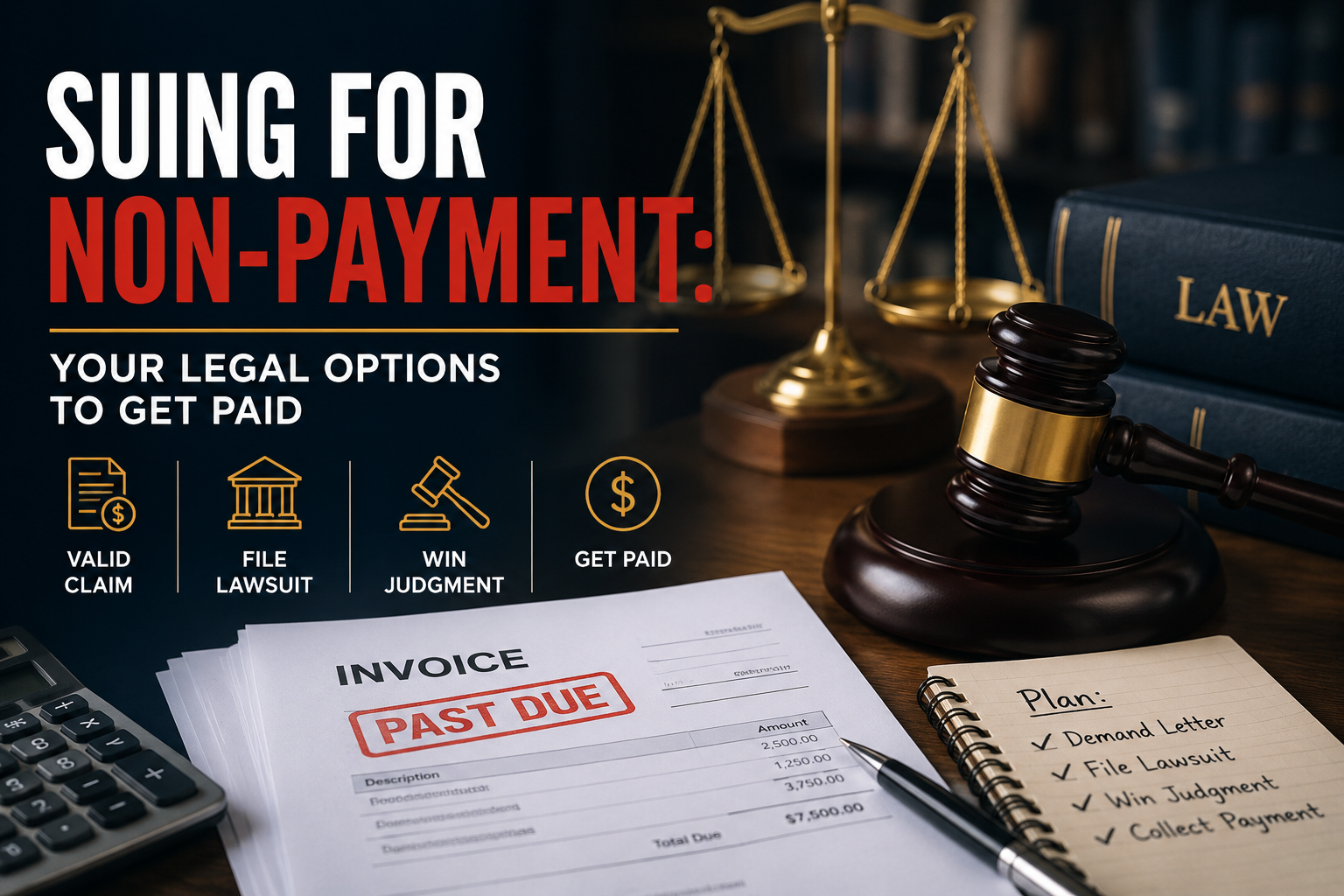
Understanding Your Rights, the Legal Process, and What It Takes to Get Paid
If your business provided goods, services, or labor—and the client didn’t pay—you’re probably wondering: Can I sue for non-payment in Florida? The answer is yes, but whether you should file a lawsuit (and how) depends on several important factors.
As a Florida construction and business attorney, I help companies recover what they’re owed—through demand letters, lawsuits, liens, and everything in between. This guide walks you through the legal process of suing for non-payment and what to expect if you go to court.
✅ When You Can Sue for Non-Payment
You can sue when someone fails to pay a valid debt owed to your business. Common examples include:
- Unpaid invoices for services rendered
- Non-payment for goods delivered
- Breach of contract (verbal or written)
- Partial payments with a remaining balance
- Refusal to pay for completed work after delivery
You don’t need a signed contract to sue—but having one makes your case stronger. Even without a written agreement, Florida law allows claims for open account, account stated, or unjust enrichment, depending on the circumstances.
⚖️ What Legal Claims Are Available?
In most non-payment cases, your attorney will use one or more of the following legal claims:
- Breach of Contract: Most common when there’s a signed agreement or clear terms.
- Account Stated: Used when both parties agreed on an amount, even if not in writing.
- Open Account: Applies when multiple unpaid invoices exist under an ongoing business relationship.
- Unjust Enrichment: Available when someone received a benefit from your business but didn’t pay—even without a contract.
Your attorney will help determine the strongest legal theory for your situation.
🏛️ Small Claims vs. County or Circuit Court
Florida divides lawsuits by dollar amount:
- Small Claims Court: Up to $8,000 (excluding interest, costs, and fees).
- Faster process
- Informal rules
- Ideal for simple debt recovery
- County Court: $8,001 to $50,000
- Formal procedures
- May require discovery and hearings
- Circuit Court: Over $50,000
- Full litigation process
- Complex disputes and higher-value claims
Choosing the right venue is key to efficiency and cost control.
💸 Can You Recover Attorney’s Fees and Interest?
You can only recover attorney’s fees if your contract says so. Florida law requires a “prevailing party” clause that allows the winner to recover legal costs.
Example:
“In any action to enforce this Agreement, the prevailing party shall be entitled to reasonable attorney’s fees and costs.”
You may also be able to collect prejudgment interest and late fees, if your contract allows—or under statutory interest rates.
✅ Tip: We review your contract before filing to make sure you’re not leaving recoverable amounts on the table.
📄 What Does the Lawsuit Process Look Like?
- Initial Review
We evaluate your claim, invoices, and contract terms to determine the best legal strategy. - Demand Letter (Optional, But Strategic)
We often send a formal legal demand before filing suit. This alone resolves many disputes. - File the Complaint
A lawsuit is filed in the proper Florida court. The defendant is served with legal papers. - Response & Discovery
The defendant must respond. If they deny the claim, both sides may exchange evidence. - Settlement or Trial
Many cases settle. If not, we take it to court and seek a judgment for the full amount owed—plus fees and interest, if available. - Enforce the Judgment
Winning the case is step one. We then pursue garnishment, bank levies, or other tools to actually collect the judgment.
🧠 Should You File Suit or Use a Collection Agency?
Collection agencies can chase basic debts—but they can’t:
- File lawsuits
- Recover attorney’s fees
- Enforce legal remedies (like liens or garnishment)
- Give legal advice or send demand letters with real authority
If the amount owed is significant or the debtor is ignoring you, working with a Florida business attorney gives you real leverage.
👨⚖️ How Douglas Law Firm Can Help
We represent Florida businesses, contractors, and professionals in recovering unpaid balances through:
- Strategic demand letters
- Contract-based litigation
- Construction lien and bond claims
- Judgment enforcement
- Contract drafting to avoid future issues
Whether your client didn’t pay for services, supplies, or commercial rent, we can help you pursue every legal avenue to recover what’s owed.
📞 Ready to Take the Next Step?
If you’ve waited long enough, it’s time to act. Don’t let unpaid invoices linger and go stale—Florida law gives you tools to collect, but deadlines apply.
📌 Contact Douglas Law Firm today to speak with a Florida business attorney and find out the best path forward to get paid.