
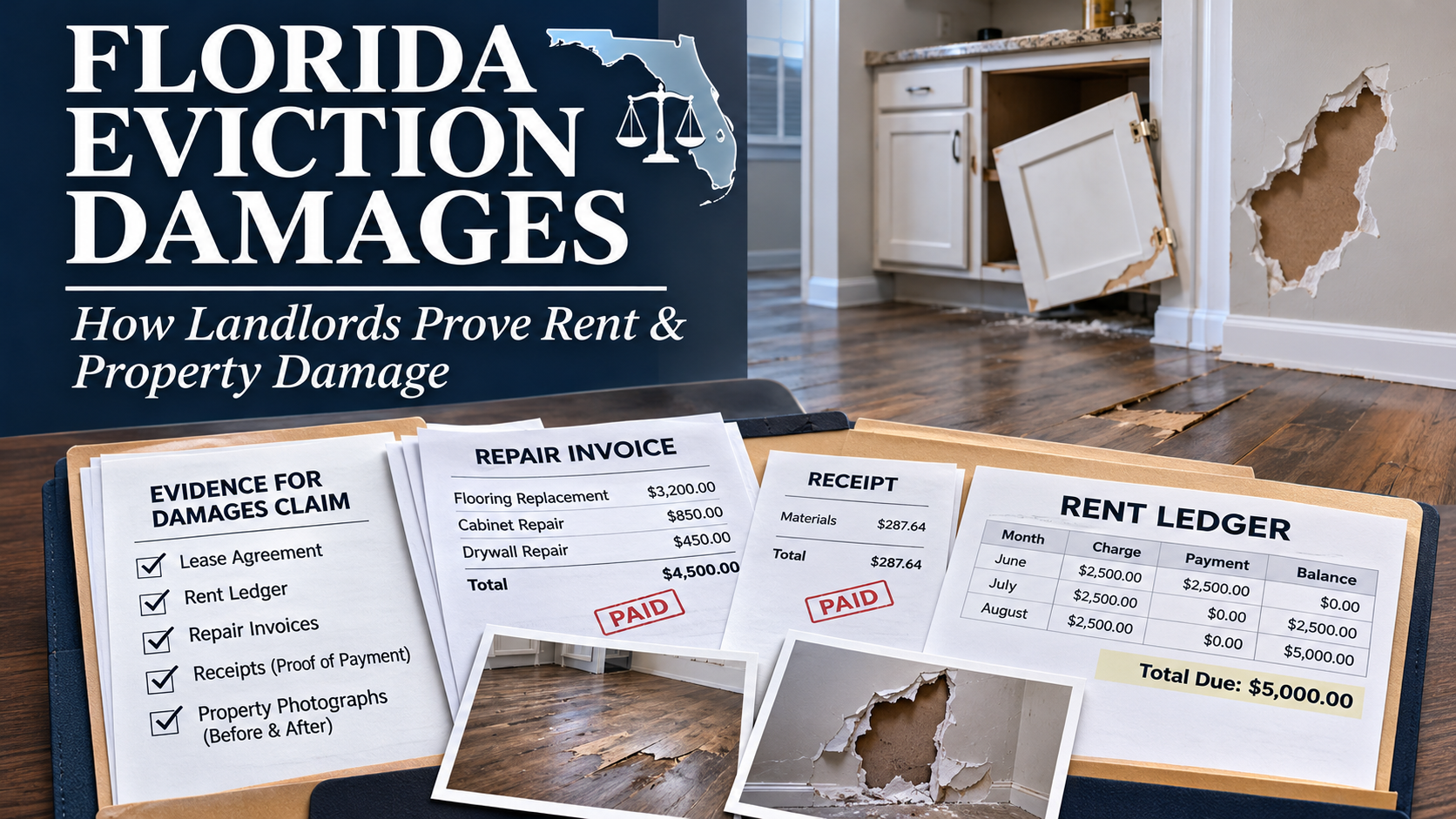
Winning an eviction case in Florida does not automatically mean a landlord will recover money for unpaid rent, property damage, cleaning expenses, or repairs. Obtaining possession of a rental property and obtaining a money judgment for damages are two separate legal issues.
For Florida landlords, one of the most common problems arises when a tenant leaves a property damaged and the landlord seeks reimbursement. The landlord may have photographs of the damage, a list of repairs, and estimates from contractors. However, that evidence may not be sufficient to establish the amount of damages the landlord is entitled to recover.
Courts require evidence of actual, legally recoverable damages—not simply an estimate of what a landlord believes the repairs will cost.
Understanding what documentation is needed before going to court, including the lease provisions establishing the tenant’s obligations, can make the difference between recovering legitimate damages and having a claim reduced or denied.
Understanding Damages Claims in Florida Eviction Cases
Florida eviction proceedings frequently involve two distinct claims:
- Possession: The landlord seeks to recover possession of the rental property.
- Monetary damages: The landlord seeks a money judgment for unpaid rent, property damage, or other amounts recoverable under the lease and applicable law.
A landlord may successfully evict a tenant but still need to prove the amount of any financial losses.
Florida Statutes Section 83.625 addresses money judgments for unpaid rent in residential eviction proceedings based on nonpayment of rent, subject to applicable procedural, service, and jurisdictional requirements. Other damages, such as physical damage to the rental property, generally require a properly pleaded claim supported by the lease, applicable law, and competent evidence.
The distinction matters because a court’s decision that a tenant must vacate does not automatically establish that the tenant owes every amount claimed by the landlord.
Proving Unpaid Rent in a Florida Eviction Case
Unpaid rent is generally more straightforward to establish than physical damage to a rental property because the amount owed can often be calculated from the lease and payment records.
However, landlords should not assume that simply stating the tenant owes rent will be sufficient.
Documents Needed to Prove Unpaid Rent
A landlord seeking unpaid rent should be prepared to present:
- The signed lease agreement: Establishes the monthly rental amount, payment due dates, and other relevant obligations.
- A complete rent ledger: Identifies each month’s rent charges, payments received, credits, and outstanding balances.
- Payment records: Bank statements, payment portal records, canceled checks, or other records confirming payments received.
- A calculation of the outstanding balance: Shows exactly how the landlord calculated the amount requested.
- Security deposit and prepaid rent information: Identifies deposits, advance rent, and any credits that must be considered.
Why a Rent Ledger Is Important
A rent ledger provides the court with a clear accounting of the tenant’s payment history.
For example, if the monthly rent is $2,500 and the tenant failed to pay for July and August, the landlord’s ledger should show the $5,000 balance, together with any applicable credits or payments.
The landlord should also be prepared to explain how the ledger was maintained and identify the records supporting the entries.
A ledger that contains unexplained charges, missing payments, or inconsistent balances can create unnecessary disputes.
Best practice: Bring the lease, an updated rent ledger, and supporting payment records to the damages hearing. Be prepared to explain each amount requested.
Proving Property Damage After a Florida Eviction
Property damage claims are often considerably more difficult to prove than unpaid rent.
A landlord may recover possession and discover damaged flooring, broken appliances, holes in walls, damaged cabinets, or other conditions requiring repairs.
Although the landlord may reasonably believe the tenant is responsible, the court must determine several issues before awarding damages:
- Did the tenant cause the damage?
- Does the damage exceed ordinary wear and tear?
- Is the tenant legally responsible under the lease or applicable law?
- What is the reasonable amount necessary to compensate the landlord for the damage?
- Has the landlord provided sufficient evidence to establish that amount?
A landlord must be prepared to establish both the tenant’s responsibility and the amount of recoverable damages.
Why Photographs Alone May Not Be Enough
Photographs are important evidence. They can establish the condition of the property after the tenant vacated.
However, photographs generally do not establish the actual cost of repairs.
For example, photographs showing damaged kitchen cabinets may demonstrate that repairs are necessary. They do not establish whether the reasonable repair cost is $500, $2,000, or $8,000.
To establish the monetary loss, the landlord should present additional documentation showing the nature, necessity, and reasonable cost of the repairs.
Actual Repair Expenses: Why Paid Invoices and Receipts Matter
One of the strongest ways to prove property damage is through documentation of actual repair expenses incurred by the landlord.
Rather than relying on a general estimate, landlords should maintain records demonstrating what work was performed, what materials were purchased, and what amounts were charged or paid.
Paid Invoices and Receipts
The most persuasive documentation will often include:
- Itemized invoices from contractors identifying completed repairs.
- Receipts for materials purchased to repair the damage.
- Proof of payment, including canceled checks, credit card statements, or bank records.
- Photographs documenting the condition before and after repairs.
- Records connecting each repair expense to damage caused by the tenant.
For example, suppose a tenant damages the flooring in a rental property.
The landlord hires a flooring contractor who removes the damaged flooring and installs replacement flooring for $3,200.
At the damages hearing, the landlord can present the contractor’s itemized invoice, proof of payment, and photographs showing the damage and completed repairs.
This provides the court with evidence of an actual expense rather than a speculative repair figure.
Why Repair Estimates Can Be Problematic
Consider a different situation.
A landlord claims that a tenant caused $7,500 in property damage. The landlord presents photographs and a contractor’s estimate stating that repairs will cost $7,500.
However, the repairs have not been completed, no materials have been purchased, and the landlord has not paid or incurred any repair expenses.
The landlord may have difficulty establishing the amount of recoverable damages based solely on that estimate.
A contractor’s estimate is not the same as a paid invoice or proof that an expense was actually incurred.
An estimate may be relevant evidence of reasonable repair costs, particularly when supported by appropriate testimony. Florida law does not categorically require every repair to be completed and paid for before damages can be recovered.
Nevertheless, estimates alone may be challenged as speculative, unsupported, or insufficient to establish the proper measure of damages.
For this reason, landlords seeking property damage awards should, whenever practical, complete the necessary repairs and preserve documentation of the actual expenses.
Unpaid Invoices Versus Estimates
There is also an important distinction between an unpaid invoice and a repair estimate.
An invoice for work that has actually been completed may establish an expense incurred by the landlord, even if payment remains outstanding.
An estimate for work that has not been performed generally represents a projected future expense.
Courts may consider both types of evidence, but completed work supported by legitimate invoices and payment records generally provides a stronger foundation for proving actual damages.
What Evidence Should a Landlord Bring to a Property Damage Hearing?
Landlords pursuing property damage claims should organize their evidence before the hearing.
1. The Lease Agreement
The lease should establish the tenant’s obligations concerning maintenance, property condition, and responsibility for damage.
The landlord should identify the specific provisions supporting the claim.
The Lease Should Clearly Define the Condition in Which the Property Must Be Returned
A well-drafted lease is an important part of establishing a landlord’s right to recover property damage.
The lease should expressly identify the condition in which the tenant is required to return the property at the end of the tenancy.
This can include requirements that the tenant:
- Return the property in substantially the same condition as when possession was delivered, except for ordinary wear and tear.
- Repair or pay for damage caused by the tenant, occupants, guests, or other persons for whom the tenant is legally responsible.
- Remove personal belongings, trash, and debris, subject to applicable legal requirements.
- Return the property in a reasonably clean condition, subject to the lease and applicable law.
- Return all keys, access devices, and other property belonging to the landlord.
The lease should also specify the tenant’s responsibility for reasonable repair, replacement, and cleaning expenses arising from a failure to comply with these obligations.
For example, if a landlord seeks reimbursement for excessive cleaning or damaged flooring, a specific lease provision addressing the property’s required condition at surrender can help establish the tenant’s contractual responsibility.
A vague lease provision can make a damages claim more difficult to prove. Landlords should avoid relying solely on general language requiring tenants to maintain the property.
However, even a clearly written lease does not eliminate the need to prove that the tenant breached its obligations and that the amounts claimed are reasonable and supported by evidence.
Landlords should also complete a move-in inspection, document the property’s initial condition with photographs, and maintain those records throughout the tenancy. These records can help establish whether the tenant returned the property in the condition required by the lease.
A properly drafted lease, combined with move-in and move-out photographs, legitimate repair invoices, and proof of expenses, provides a substantially stronger foundation for recovering property damage in court.
2. Move-In and Move-Out Photographs
Photographs showing the property’s condition before the tenancy and immediately after the tenant vacates can help establish that the damage occurred during the tenancy.
Dated photographs, inspection reports, and videos are especially useful.
3. Itemized Repair Invoices
Each invoice should identify the contractor, work performed, date of service, and amount charged.
Vague invoices describing the work only as “property repairs” may be less persuasive than invoices identifying the actual repairs completed.
4. Proof of Payment
Landlords should retain canceled checks, credit card statements, bank statements, and payment confirmations.
These documents help demonstrate that the expenses were legitimate and actually paid.
5. Material Receipts
If the landlord purchased materials directly, receipts should identify the items purchased and their cost.
The landlord should be prepared to explain how those materials were used to repair tenant-caused damage.
6. Testimony Supporting the Damages
Documents do not necessarily prove themselves.
The landlord, property manager, contractor, or another appropriate witness may need to testify about the condition of the property, the work performed, the necessity of the repairs, and the reasonableness of the expenses.
Depending on the circumstances, additional testimony may be necessary to authenticate records or establish the proper measure of damages.
Normal Wear and Tear Is Not the Same as Property Damage
Florida landlords must distinguish between damage caused by a tenant and deterioration resulting from ordinary residential use.
For example, minor carpet wear, ordinary paint fading, and reasonable aging of fixtures may constitute normal wear and tear.
By contrast, broken doors, large holes in walls, destroyed flooring, and other damage resulting from misuse or negligence may support a claim.
The landlord should also consider the age and condition of the damaged item.
Landlords Cannot Automatically Charge for Brand-New Replacements
Suppose a tenant damages carpeting that was already several years old.
The landlord replaces the carpeting with brand-new materials and seeks reimbursement for the entire replacement cost.
Depending on the facts, the court may determine that the full replacement cost would improperly improve the property’s condition beyond what existed before the damage.
The reasonable cost of repair, depreciation, prior condition, and whether replacement was necessary may all affect the amount recoverable.
The purpose of compensatory damages is to compensate the landlord for a proven loss, not to provide an unwarranted improvement to the property.
Cleaning Charges, Trash Removal, and Other Expenses
Property damage claims may also include expenses beyond physical repairs.
Examples include excessive cleaning, removal of abandoned debris, replacement of damaged fixtures, and other expenses attributable to the tenant’s breach of the lease.
As with physical damage, the landlord should preserve actual documentation.
For example, if a landlord hires a cleaning company for $650 to address conditions beyond ordinary cleaning, the landlord should retain the invoice, proof of payment, and photographs demonstrating why the work was necessary.
Simply requesting $650 for cleaning without supporting documentation may not establish that the charge is reasonable or recoverable.
Similarly, a landlord who personally performs cleaning or repairs should not assume that an arbitrary hourly charge will be accepted. Any claim for personal labor must have an appropriate legal and evidentiary basis.
Security Deposits Must Be Properly Accounted For
Security deposits can affect the amount a landlord ultimately seeks to recover.
Florida Statutes Section 83.49 establishes procedures governing residential security deposits, including notice requirements when a landlord intends to impose a claim against the deposit.
Generally, when the statutory notice requirement applies, the landlord must provide notice of the intended claim within 30 days after termination of the rental agreement. The statute specifies the required notice contents and permitted delivery methods, including certified mail and electronic notice satisfying Section 83.505.
Failure to comply with applicable requirements can affect the landlord’s right to retain the deposit. Under Section 83.49, a landlord who fails to give required notice may still pursue a separate action for damages after returning the deposit.
Landlords should also avoid seeking a double recovery by claiming damages already satisfied through security deposit deductions or other payments.
Accurate accounting is essential.
Common Mistakes Landlords Make When Seeking Eviction Damages
Several recurring mistakes can weaken an otherwise legitimate claim:
- Relying entirely on estimates: Presenting anticipated repair costs without completed work, supporting testimony, or other sufficient evidence.
- Failing to keep receipts: Paying contractors or purchasing materials without maintaining records.
- Having an inadequate lease: Failing to clearly identify the condition in which the tenant must return the property and the tenant’s responsibilities for damage.
- Claiming ordinary wear and tear: Attempting to charge tenants for routine deterioration.
- Failing to document the property’s prior condition: Making it difficult to establish that the tenant caused the damage.
- Submitting unexplained charges: Providing a list of expenses without showing what work was performed or why it was necessary.
- Seeking replacement costs without considering prior condition: Requesting the full cost of new materials when the damaged items were already substantially depreciated.
- Failing to account for deposits or credits: Seeking amounts that have already been paid or otherwise recovered.
- Failing to properly plead the claim: Assuming that a request for possession or unpaid rent automatically includes a claim for physical property damage.
These mistakes can result in a court reducing or denying some or all of the requested damages.
Can a Landlord Recover Property Damage Without Completing the Repairs?
Potentially, yes.
Florida law does not impose a universal requirement that a landlord must complete and pay for every repair before seeking compensation.
Depending on the circumstances, the reasonable cost of necessary repairs may be established through competent testimony, reliable estimates, expert evidence, or other admissible proof.
However, the landlord still bears the burden of proving the existence and amount of recoverable damages with reasonable certainty.
An unsupported estimate or a landlord’s personal opinion about what repairs should cost may not be sufficient.
From a practical litigation standpoint, actual invoices, receipts, and documented out-of-pocket expenses generally provide stronger evidence than estimates for work that may or may not be performed.
Landlords should distinguish between what the law may permit and what evidence is most likely to establish their claim persuasively in court.
Preparing a Damages Claim Before Going to Court
A landlord should begin preparing a potential damages claim as soon as possession is recovered.
Before making repairs, photograph the property thoroughly and document the condition of each damaged area.
As repairs proceed, maintain an organized file containing contractor invoices, material receipts, payment confirmations, and photographs of completed work.
Prepare an itemized summary identifying each category of damages, the amount claimed, and the supporting documentation.
The landlord should also confirm that the requested damages are authorized by the lease or applicable law and have been properly included in the lawsuit.
Landlords should not assume that they can simply appear at an eviction hearing with photographs and a list of estimated repair costs and expect the court to award the amounts requested.
Taking these steps before the hearing can substantially improve the presentation of the claim.
Frequently Asked Questions About Florida Eviction Damages
Can a Florida landlord recover property damage in an eviction lawsuit?
Yes, a landlord may pursue compensation for tenant-caused property damage through an appropriate damages claim. However, recovering possession does not automatically establish liability for physical damage, and the claim must be properly pleaded and supported by sufficient evidence.
Are repair estimates enough to prove property damage?
Not necessarily. Estimates may be admissible and relevant, but an estimate alone may not establish the reasonable amount of damages. Completed repairs supported by itemized invoices, receipts, and payment records generally provide stronger evidence.
Does a landlord have to complete repairs before recovering damages?
Not in every case. A landlord may be able to establish recoverable repair costs without completing the work, but must present legally sufficient evidence of the damages. Actual repair expenses are often easier to substantiate than projected costs.
What documents prove unpaid rent in a Florida eviction?
A signed lease, complete rent ledger, payment history, and supporting financial records are generally important. The landlord should also account for applicable credits, deposits, and prepaid rent.
Should a Florida lease specify the condition in which the tenant must return the property?
Yes. A properly drafted lease should clearly establish the tenant’s obligations concerning the condition of the property at the end of the tenancy, including responsibility for damage beyond normal wear and tear, reasonable cleaning requirements, and removal of belongings. Clear provisions can help establish contractual responsibility when pursuing a damages claim.
Can a landlord charge a tenant for normal wear and tear?
Generally, landlords cannot recover damages for ordinary deterioration resulting from normal use. Claims should focus on damage beyond normal wear and tear for which the tenant is legally responsible.
Can a landlord recover attorney’s fees and court costs?
Depending on the applicable statutes, lease provisions, and procedural circumstances, a prevailing landlord may be entitled to recover attorney’s fees and court costs. Entitlement and the reasonable amount of fees may require separate court determinations.
Conclusion: Proper Lease Terms and Documentation Are Essential to Recovering Florida Eviction Damages
Florida landlords should understand that proving a tenant caused damage is not the same as proving the amount of damages the court should award.
A successful damages claim begins with a properly drafted lease that clearly establishes the condition in which the tenant must return the property and identifies the tenant’s responsibility for damage beyond ordinary wear and tear.
For unpaid rent, a complete rent ledger supported by the lease and payment records is essential.
For property damage, the strongest evidence will often consist of move-in and move-out photographs, itemized invoices for completed repairs, actual receipts, proof of payment, and testimony connecting those expenses to tenant-caused damage.
Although repair estimates may have evidentiary value, landlords should not assume that an estimate alone will support a money judgment.
Clear lease provisions, documented property conditions, legitimate out-of-pocket expenses, and proper preparation are critical to proving Florida eviction damages in court.
Contact Douglas Firm for Assistance With Florida Evictions and Damages Claims
Douglas Firm represents Florida landlords in residential and commercial eviction matters, unpaid rent claims, and landlord-tenant disputes.
Whether you are seeking possession of a rental property, attempting to recover unpaid rent, or pursuing compensation for tenant-caused property damage, proper preparation and documentation are important to protecting your interests.
Contact Douglas Firm, located in Weston, Florida, to discuss your eviction or damages claim. The firm assists landlords throughout Broward County and South Florida.
This article provides general information about Florida law and is not legal advice for any particular situation.